
USS students have say on Uxbridge future
Roger Varley, Local Journalism Initiative Reporter
Uxbridge Secondary School held a Youth Forum last week which saw a number of students work their way through a number of sessions aimed at showing them how a municipal government works. The summit was aimed to help the youth learn about and help shape Uxbridge in the future.
The summit, organized by school principal Melissa Lee and Canadian and World Studies teacher Craig Marlatt, had 80 students participants (pictured above, with organizers and presenters), all armed with iPads or tablets and hooked up to an app called Kahoot, which enabled them to instantly respond to questions in each session, with the results of their answers instantly displayed on a large screen.
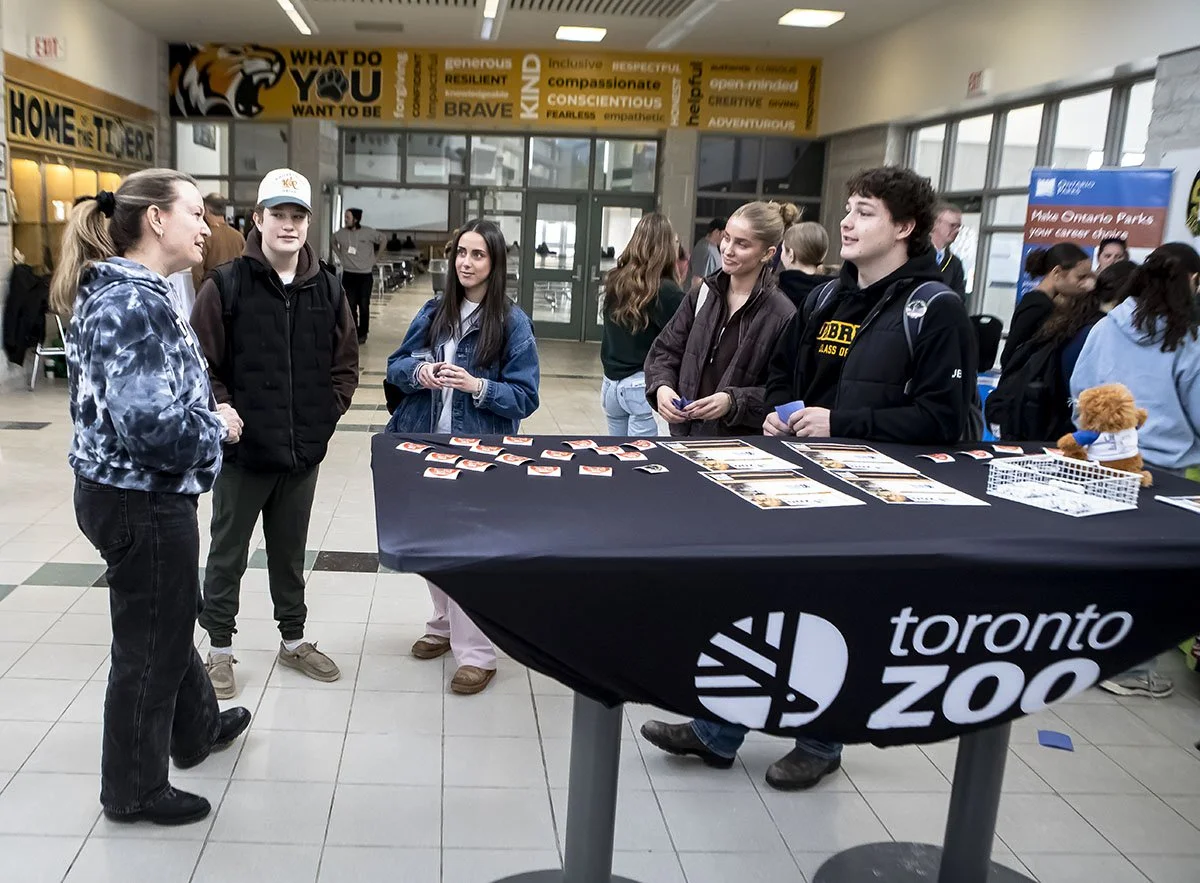
USS students learn about job opportunities at the Toronto Zoo. Photo by John Cavers
The students were broken up into six groups, which then rotated through the six sessions. The Cosmos was invited to follow one group as it worked its way through the exercise.
The first stop was a visit to the five universities and one college who had tables set up to explain some of their curricula and to give students a look at what they had to offer in the way of possible future career paths, especially as they related to the environment and urban planning.
At the University of Guelph set-up, which promoted courses on rural planning and diversity, students were asked to write down on Post-It notes what their concerns were. Among other things, students said they were concerned about house prices, food insecurity, loss of farmland and healthcare.
The Seneca College table offered the students a short game of “Jeopardy” which was centred around tourism. One question asked “What is the oldest hotel in the world?” No one had the correct answer. (Nishiyama Onsen Keiunkan in Japan, opened in 705.
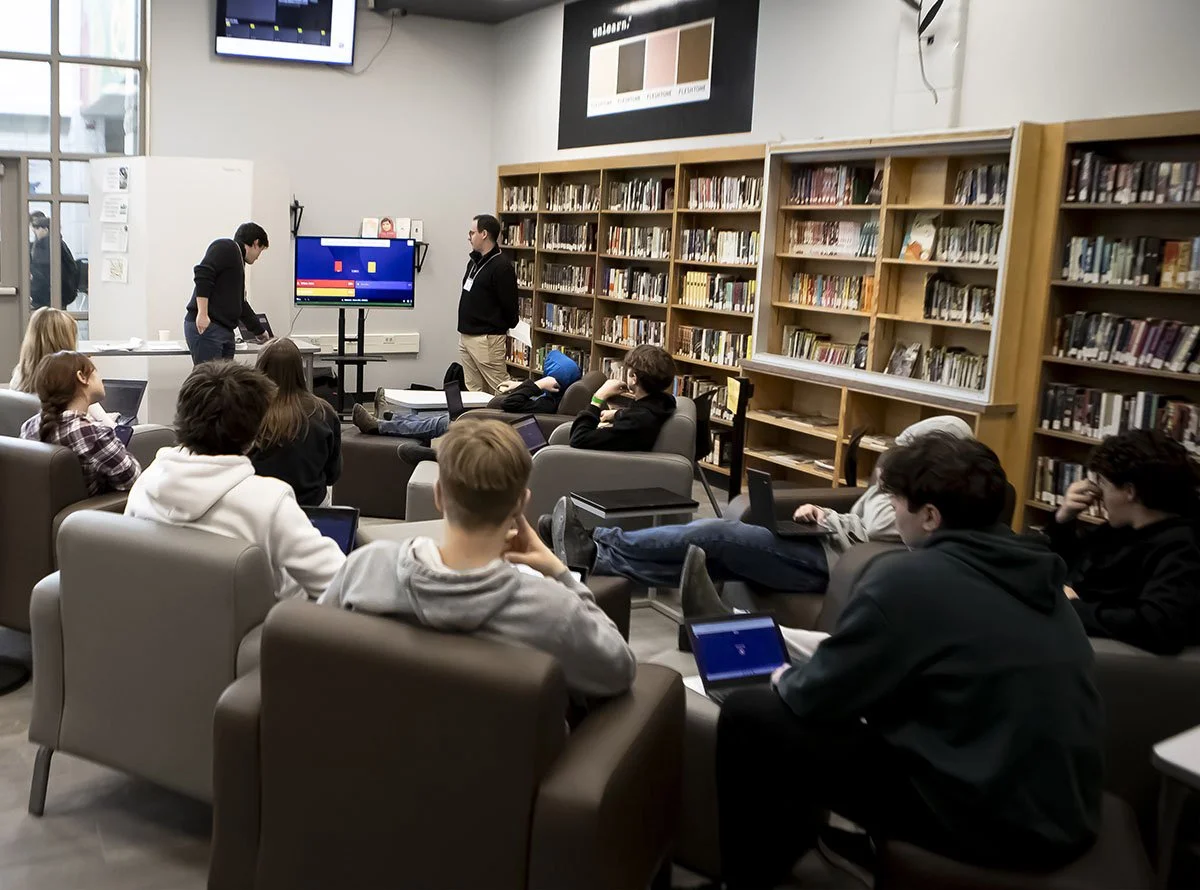
Representatives from the planning department of the Township of Uxbridge work with students as they submit poll results via Kahoo. Photo by John Cavers
In the second session, they learned of the township's planning process and the rules that have to be followed. In the interactive segment on Kahoot, the polling revealed that the students felt heritage should be preserved, more restaurants are needed downtown and they would prefer more single homes than apartments for housing options.
Mary Bridger, chair of the Uxbridge Downtown Advisory Committee, was joined by councillor Willie Popp in describing what downtown revitalization is all about and what it will mean to the downtown. When asked what they would like to see as a result of the revitalization, the students again said they wanted more restaurants, a gathering place and a better streetscape. However, 80 per cent of the students in the group said they did not expect to be living in Uxbridge in 10 years time.
The students then engaged in a session about the proposed development of Centennial Park. Again using the Kahoot app, the students were asked to give their responses to 32 questions. Landscape Planning landscape architects, the company charged with redesigning Centennial Park and presenting these designs to council, collected the answers from all the students who participated and will use this information when moving forward with ideas and concepts for the space.
From Centennial Park, the students moved to a session hosted by Ontario Parks, which gave the students a brief introduction to the new Uxbridge Urban Provincial Park, and some of the processes that are applied when deciding how to zone a park.
Student Bennett Sewell said after the forum that "it was nice to have them hear our views," adding that the forum would be more beneficial to Grade 9 students since those in Grades 11 and 12 have mostly already made their plans for post-secondary education and careers.
Marlatt said the forum met his expectations and he was happy with the students' involvement, as well as the support from the community agencies that attended. He added he isn't sure whether the Forum will be repeated, but he hopes there will be regular opportunities for the youth to have a voice on all community projects.
"The students were inspired to share their voices more," he said. "They liked the format. It wasn't just sit and listen. They were involved."