
The wonders of woodpeckers
with Nancy Melcher, the Nature Nut
As I write this, I remember back 40 years to our first morning in our new/old house. Friends helped us move and we settled into bed, tired but excited to continue unpacking the next morning. What should have been a gentle awakening the next day was rudely shattered, well before the break of dawn, by an incredibly LOUD staccato noise, a weird metallic buzz/bang emanating from somewhere down the hallway. It shattered our sleep, and made us sit bolt upright exclaiming, “What the heck was THAT?!”
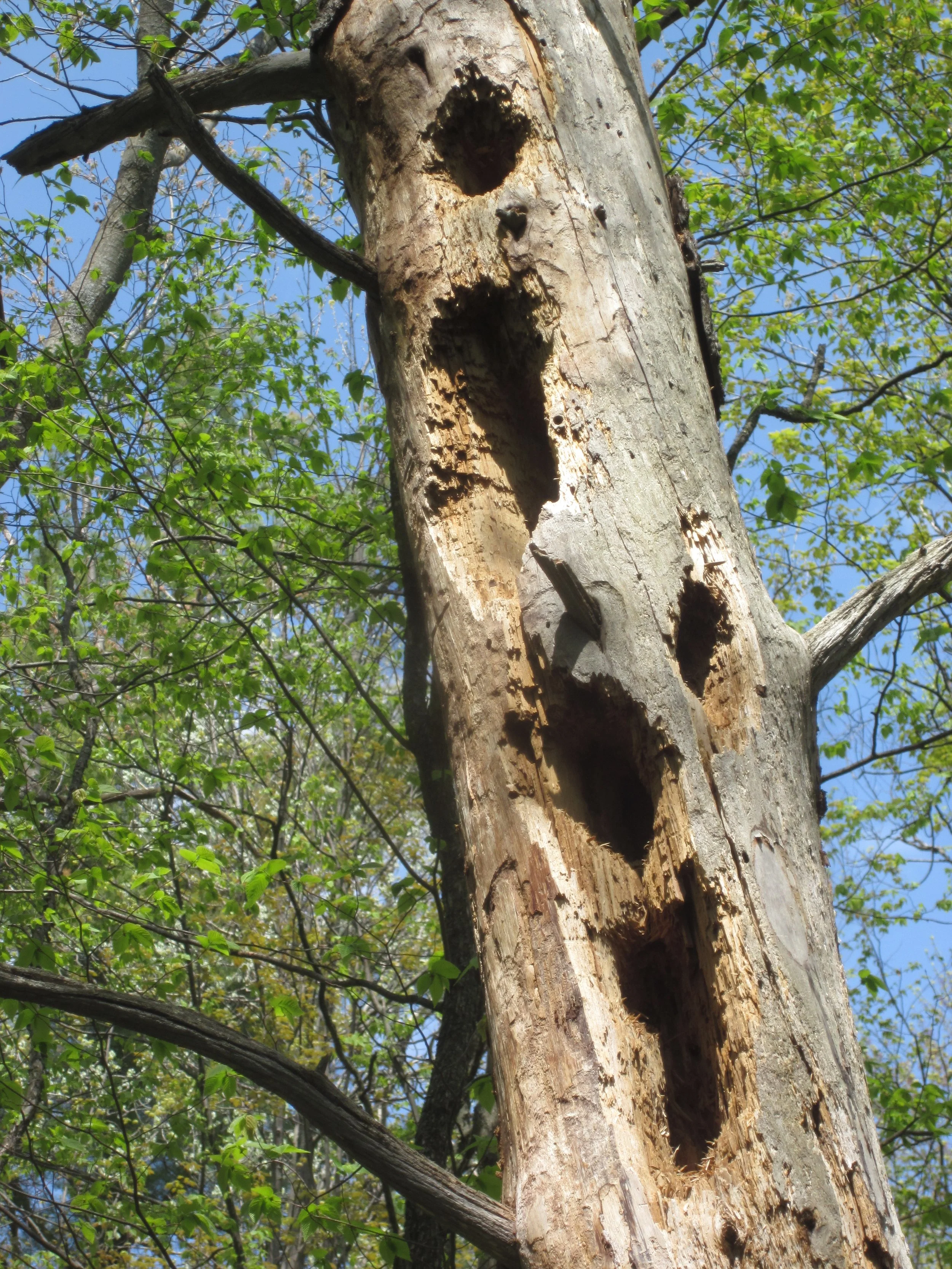
Holes in a pine tree, created by a pileated woodpecker. Photo by Nancy Melcher
The noise repeated several more times as we explored our new surroundings, hunting for the source, until we traced it to the furnace exhaust pipe. A quick trip outside (fully dressed for that urgent exit) led me to discover a medium-sized woodpecker hammering repeatedly on the metal pipe extending up through the roof! It was my first close encounter with the territorial behaviour of these amazing insect-eating birds.
Wood peckers - their name certainly explains a lot. They use their chisel-like beaks to make holes in trees to reach insects living within, and to excavate larger cavities in which to nest. A recent conversation while skiing on the rail trail triggered my search to discover how they manage to bang their heads on trees (and pipes) but not get a concussion!
It turns out their brain is much smoother than ours, and they have less tissue surrounding it. That much tighter fit keeps their brain from rattling and bouncing around inside their head. Additionally, their tongue is extremely long, stretching completely around the skull and acting as a cushion. Finally, they don’t peck continuously. It creates heat, so they must only drill in short bursts to allow their head to cool between rounds.
There are nine different species that live in eastern Canada: downy, hairy, red-bellied, pileated, red-headed, black-backed, three-toed, yellow-bellied sapsucker, and northern flicker. The first three visit my feeders. The smallest, and most common, is the sparrow-sized downy and the largest is the pileated (PILE-ee-ate-ed OR PILL-ee-ate-ed) that’s almost as big as a crow. Most have black and white plumage with some red highlights as their names suggest. They use their tail to brace against trees, and their toes are spaced two forward and two backwards.
Recently, a loyal reader told me about a pileated that had ransacked a magnificent spruce tree on his property. This persistent bird chiselled huge holes all the way around the trunk, compromising the structural integrity of the tree. Despite the owner’s efforts to dissuade it by stapling woven wire mesh over the holes, the bird easily removed those defences to continue its attack on the tree. It’s likely infested with carpenter ants, a pileated’s favourite meal. The tree will need to come down, for safety reasons.
Back to my unpleasant awakening. The northern flicker that hammered out his deafening “good morning” bursts that day was using the fantastic resonance quality of our pipe to drum out the boundaries of his territory. Woodpeckers choose dry branches or hollow trunks that resonate very well but also may use downspouts, gutters, and … furnace pipes. These non-vocal communications are the same as other birds’ songs, like a robin’s “cheeriup, cheerio, cheerily”, or the “caw” of crows, and the chickadee’s spring serenade of “hey sweetie.”
It’s all part of the wonderful spring chorus of sounds that are returning to our neighbourhoods, nearby forests, ponds, and fields. All too soon we will be hearing another very common sound – that awesome, irritating, high-pitched whine of mosquitoes! Enjoy the occasional blasts of sound from nature’s feathered percussionists as they drum out, “this is MY place!” for all to hear.
Nancy Melcher is The Nature Nut. Send details of your sightings or questions about the natural world to: general@melcher.cx