
Human remains found in North Bay are those of Uxbridge man
Lisha Van Nieuwenhove
More than 50 years after a partial human skull was discovered outside of North Bay, police have identified the remains as belonging to an Uxbridge man.
Last Thursday, the North Bay Police Service (NBPS) held a media conference to share that they have identified the individual as Claude Hamilton Brownscombe, who was born in Uxbridge on Oct. 24, 1896, and was a World War I veteran.
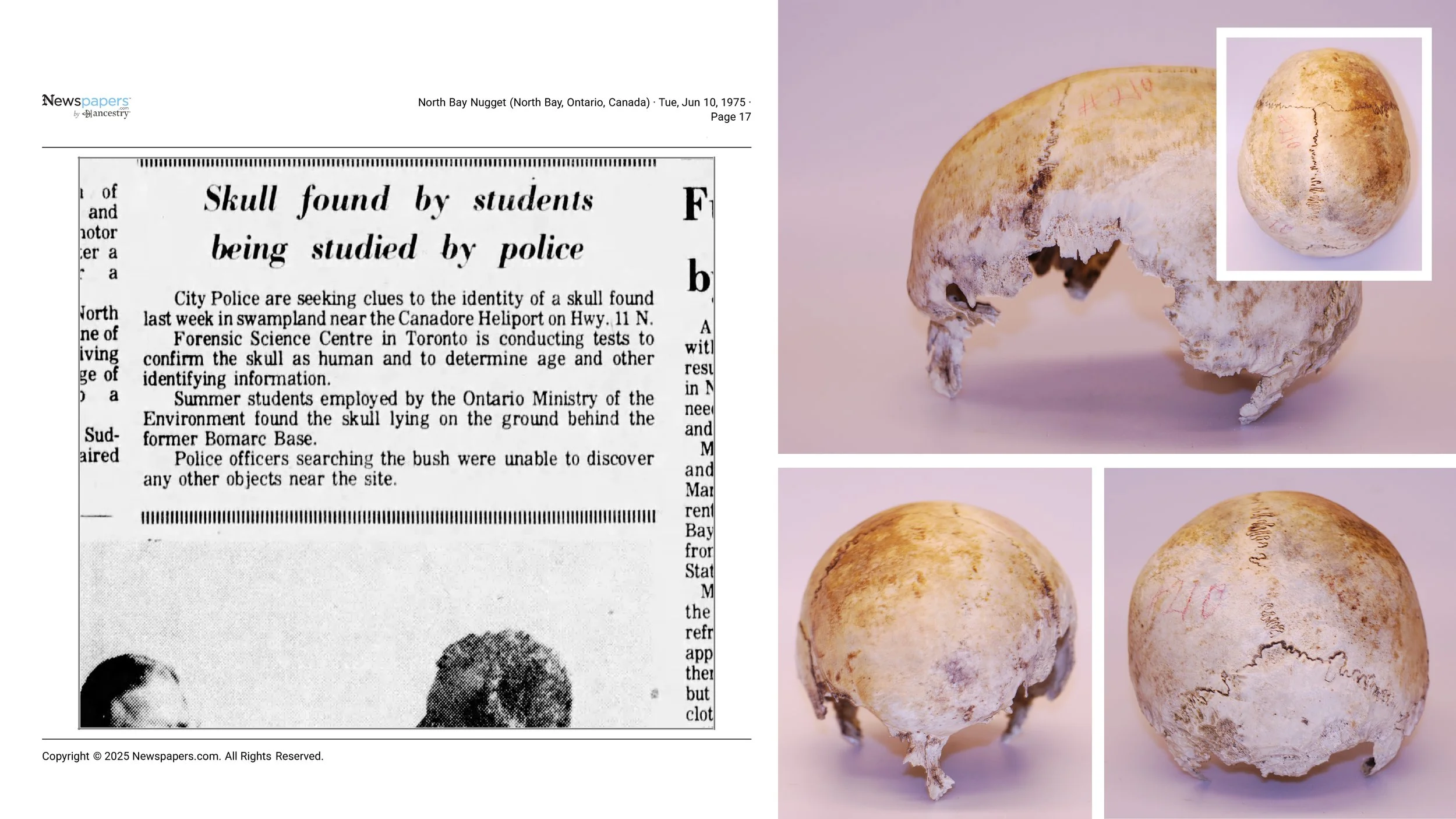
Left: a newspaper clipping from the North Bay Nugget, June 10, 1975, when the partial skull was first discovered in a swamp north of North Bay. Right: police photos of the skull remains. Photo - North Bay Police Service
According to the NBPS, the identification marks the conclusion of an investigation that began in June 1975, when a partial human skull was discovered by students working for the Ministry of the Environment in a swampland area off Highway 11 North, behind the former BOMARC missile base. Despite extensive investigative efforts over the years, the individual's identity remained unknown until advances in forensic science created new opportunities to examine the evidence.
“Advances in this area of forensic sciences have created new opportunities to revisit historic investigations and examine evidence in ways that were not possible many years ago,” NBPS Chief Daryl Longworth told reporters at the news conference.
In 2023, NBPS investigators reopened the case using Investigative Genetic Genealogy, or IGG, a forensic technique that combines DNA analysis with genealogical research. Working alongside policing partners, investigators developed new leads that ultimately confirmed the remains belonged to Brownscombe. The Office of the Chief Coroner officially confirmed the identification on June 19, and Mr. Brownscombe's next of kin have since been notified.
Using IGG, investigators developed a family tree based on Brownscombe’s DNA and were able to form and identify family connections. That led to the discovery of a married couple whose family history revealed the death and burial locations of all their children except for one son, said NBPS Det. Const. Shawn Hofmann at the news conference.
Police interviewed two of Brownscombe’s surviving family members – a great-nephew and a great-niece. Both provided DNA samples, which confirmed the match.
Hofmann shared that military records showed Brownscombe was living in Toronto in 1917 when at 22, he enlisted with the Canadian Over-Seas Expeditionary Force. He went on to serve overseas and was discharged in 1919. The military records described Brownscombe as standing five feet two inches tall, and as having blue eyes and brown hair.
Newspaper articles showed Brownscombe was living in Timmins, Ont., as early as 1928.
“He worked at the McIntyre Mine and participated in community activities, including local bowling leagues,” Hofmann said.
The great-nephew recalled seeing him in 1953 and said Brownscombe was living a quiet life in a northern Ontario cabin.
He was on voting lists in 1949 and 1957, but police did not find any records confirming his death, Hofmann said.
Investigators say they are unsure how he ended up in North Bay from Timmins. Examiners in 1975 determined Brownscombe had been dead for one or two years before his partial remains were found.
Investigators are unable to determine a cause of death, but foul play is not suspected, Insp. Scott McFarlane said.
“We recognize that today’s announcement may bring renewed emotions for some who are still missed their loved one. Please know that you are not forgotten,” he said.
“For more than five decades, this individual had no name. We are now able to say that he was Claude Hamilton Brownscombe. While our thoughts are with Mr. Brownscombe's family and loved ones, we hope this identification provides answers and a measure of closure after so many years," said Chief Daryl Longworth. "This identification reflects the dedication of our investigators, the strength of our partnerships, and the power of modern forensic science. Most importantly, it provides long-awaited answers to Mr. Brownscombe's family and to our community."
The NBPS worked with the Toronto Police Service Homicide and Missing Persons Unit; the Ontario Forensic Pathology Service through the Provincial Forensic Pathology Unit; the National DNA Databank; the Ontario Centre for Missing Persons and Unidentified Remains; and the Office of the Chief Coroner for Ontario throughout the investigation.