
Get up with the birds on World Migratory Bird Day to join NDN’s Dawn Chorus
Submitted by Barbara Samuels
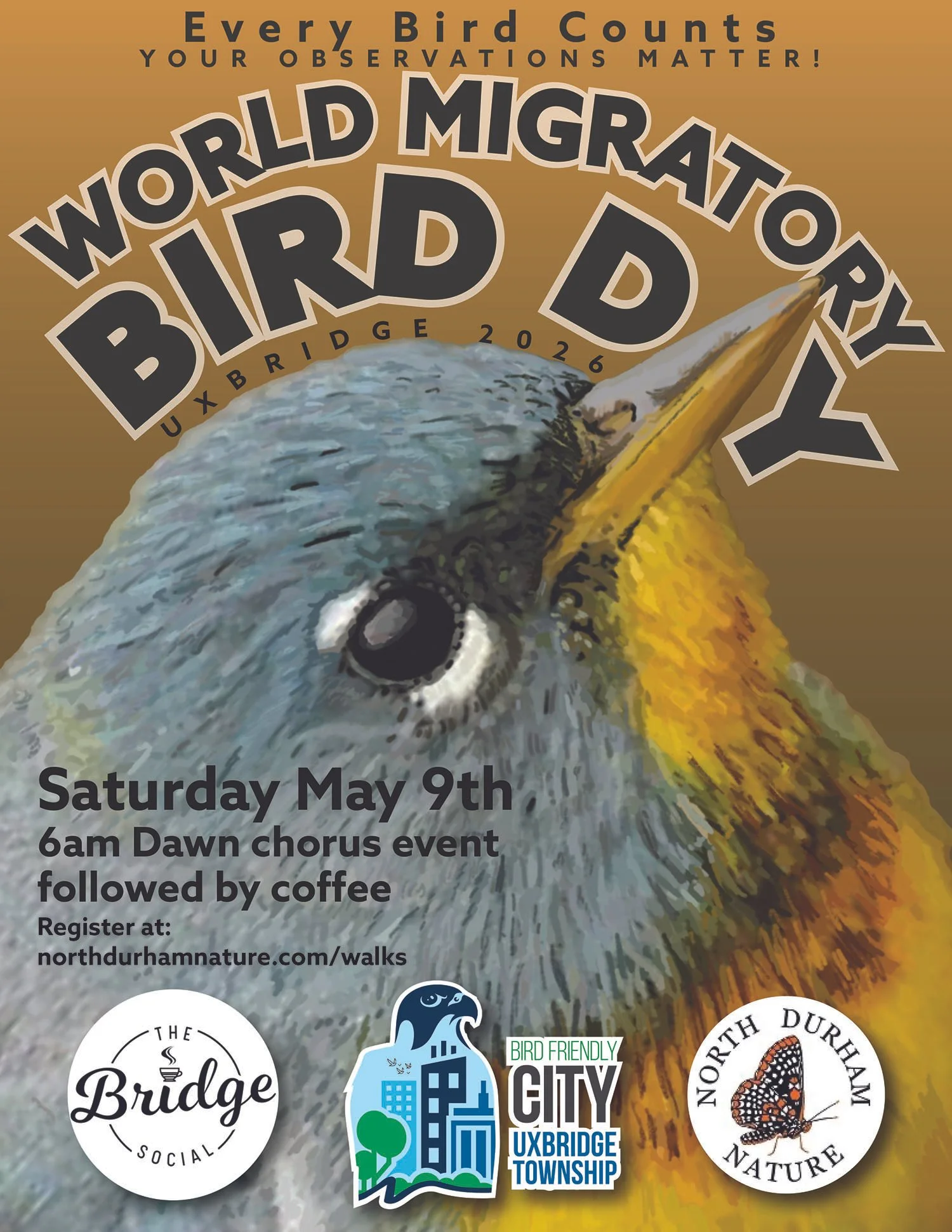
Bird Friendly Uxbridge is joining most of the western hemisphere this Saturday as communities across the Americas come together on May 9 to celebrate World Migratory Bird Day (WMBD) 2026, all highlighting this year’s theme: Community Science for Bird Conservation.
Uxbridge’s part in this giant event? Residents are asked to join with North Durham Nature on to celebrate WMBD by leading a Dawn Chorus. For those literally willing to get up before the birds, this is a unique chance to hear the morning song of freshly arrived migrants, as local experts help you to identify each one. One participant in last year’s Chorus called it “a borderline mystical experience.” Anyone interested in signing up for the Chorus can register online at northdurhamnature.com/walks. Spaces are limited.
From subarctic breeding grounds to tropical wintering habitats, millions of migratory birds depend on healthy ecosystems, and increasingly, on the people who help monitor and protect them.
Community science has emerged as one of the most powerful tools in bird conservation. Volunteers observe and report what they see in their immediate environment. This generates critical data that helps scientists and decision-makers understand migration patterns, track population trends, and respond to environmental threats.
Each year, people across North, Central, and South America take part in bird counts, habitat restoration activities, educational programs, and awareness campaigns which, in turn, sees ordinary community members help build one of the largest global datasets on biodiversity.
Bird Friendly Uxbridge team leader Carly Davenport says that the many Uxbridge residents who already participate are contributing crucial information to this international effort.
“You don’t need specialized training,” she explains. “Just record bird sightings, or get involved in one of our local bird counts. You’ll actually be making an impact on policy decisions that affect migratory birds.”
She also notes that this sharing of information creates a shared sense of responsibility.
“This is our community, our environment,” she says. “The onus is on all of us to pitch in and protect our bird population. Community Science is a great way to do that, and apps like eBird and iNaturalist make the process really easy.”
This type of data is urgently needed because migratory birds die due to habitat loss, climate change, pollution, and collisions with human-made structures. Community science is a bridge between local action and global conservation efforts, enabling real-time monitoring and rapid responses to emerging threats.
“Every observation counts, “ says Davenport, “and every participant becomes part of a larger movement. When so much in the world seems beyond our control, this is a way for each of us to actually make a difference.”